The Painting and the City reviewed by Lisa Tuttle in the Sunday Times: A “haunting tale from a distinctive new voice.” Read the whole review here.
Author: Robert Freeman Wexler
Summer Sale
PS Publishing is running a 60 percent off summer sale. Which means that remaining copies of In Springdale Town, in jacketed hardcover, are now £10.00 / $16.00. This is a numbered edition of 200 copies, each signed by myself and the introducer, Lucius Shepard.

“Wexler writes of small-town America with the same regard to detail and unnerving surreality as David Lynch. Just when you think you have a grip on what’s happening in Springdale town, its two main characters, and the story’s plot, Wexler rearranges the whole game with, I have to say it again, Lynchian instinct. With footnotes inset to give the page an air of scholarly work, In Springdale Town can’t be neatly fit into the typical contemporary fantasy molds, since as a metafiction, its audience seems to be dwelling outside typical genre boundaries.” Barth Anderson (author of Patron Saint of Plagues and The Magician and the Fool) from the website of the Interstitial Arts Foundation.
Mass Movement
New Painting and the City review by Amy Dodge at online magazine Mass Movement.
Babylonian Trilogy
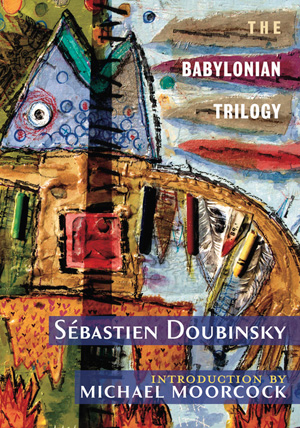 I recently finished reading The Babylonian Trilogy by Sébastien Doubinsky. The author is French, and this is his first book to be published in English. It’s one of those brain-rattling books that come along too rarely. I’m hoping it will help my current writing, slide some things around in my head till they find a better position.
Paul Witcover, in his review in Locus magazine, called it “a book whose images and characters seduce you one minute, then sucker-punch you the next.”
The setting is Babylon, a melted and mashed metropolis filled with decay, sensationalism, corruption, and beauty. The book is broken into three parts, “The Birth of Television According to Buddha,” “Yellow Bull,” and “The Gardens of Babylon” In “The Birth of Television According to Buddha,” multiple story lines and narrators alternate, including several amazing short-shorts about (or by) various colors, including:
Blue is the color of strangeness and tomorrows. It is the color of eyes and oceans. Seven is its number, and the sky is not a window. Painters use blue to express rage and lust. Blue is androgynous. Blue is the last color we will need for now. But blue is always where you expect it to be. For blue is the color of your shadow. Walk on the sunny side of the street on a cold summer day, and you will see.
“Yellow Bull,” the middle section, is the most straightforward, taking the form of a police procedural in which Georg Ratner, a disinterested police detective, is aided by dreams and nightmares to catch a serial killer. “The Gardens of Babylon” returns to a format of multiple story lines: Poetry, Death, and Dope (writer, assassin, junky).
The multiple stories and styles make it a difficult book to describe plot-wise, and in a way the plot is irrelevant. But despite its experimental clothing, the book builds story and character, characters who the reader cares about, creating a satisfying and intriguing whole.
To see some of what the author has to say about his writing, there’s a good interview here.
PS Publishing will release two more of his books next year, which is cause for rejoicing.
Bibliophile Stalker Interview
The amazing Charles Tan has posted an interview with me where I babble about various things.
Some Reviews
Jason Pettus at The Chicago Center for Literature and Photography.
And Matt Denault at Strange Horizons.
Stack of Books

It’s July, and that means The Painting and the City is officially out.
From the book jacket:
What is the secret contained in Philip Schuyler’s painting? Who was the woman he depicted, the innocent woman and her dark stalker? The Kreunen sisters know, but they must re-bury the past. And Jacob Lerner, artist flailing in a sea of commerce, can only press forward, explore his own art and the mystery of Schuyler’s painting, aided and manipulated by an animate marionette of rosy glass…
Manhattan, summer, in the rosy dawn of the 21st century, the sculptor Jacob Lerner sees a painting at a friend’s apartment and is drawn into an obsessive search for traces of its long-dead painter, fictional 19th-century artist Philip Schuyler, and his subject, a woman called Madame Burgundy. The search leads to the remains of a once-powerful but still wealthy Dutch-American secret society, and carries Lerner through real and surreal Manhattan streets, buildings, and countryside. Finding Schuyler’s journal draws Lerner in deeper. Finding the dapper marionette makes it impossible for Lerner to escape.
The Painting and the City tells a story of art and its conflict with commerce, the way art can (literally) reshape the world, and the consequences of such a reshaping.
Available in slipcased and trade hardcover editions.
Manahatta Project
Review in the July 2 New York Times of the Manahatta Project exhibit at The Museum of the City of New York. I first posted about it here.
From the museum’s site:
Mannahatta/Manhattan: A Natural History of New York City will reveal the island of Mannahatta at the time of Henry Hudson’s arrival—a fresh, green new world at the moment of discovery. Through cutting edge multi-media and historical artifacts and maps, Mannahatta/Manhattan will re-imagine the quiet, wooded island at the mouth of a great river that was destined to become one of the greatest cities on Earth. Moreover, Mannahatta/Manhattan will challenge visitors to view the city of today as a place where the relationship between nature and people is at its most important and to understand that the principles of diversity, interdependence, and interrelativity operate in a modern mega-city much as they do in nature. In doing so, the exhibition will contribute something new to the history of New York—a view of its ecological origin—and in that contribution, shape the future as well.
One of the themes of The Painting and the City concerns how New York City grew in opposition to its natural features, leveling hills, filling in bodies of water, etc., so the exhibit feels like a companion to my novel. I’ll be in New York next month for a reading (August 19th, KGB), and am very much looking forward to seeing the exhibit.
Locus Review
New review of The Painting and the City by Faren Miller in the July issue of Locus magazine. I’ve linked to an excerpt from it at the PS News Blog:
Meanwhile, Locus Magazine reviewer Faren Miller finds much to love about The Painting And The City by our very own Robert Freeman Wexler
Starred Review in Booklist
Booklist has given a starred review to The Painting and the City.
At a friend’s party in Manhattan, sculptor Jacob Lerner sees an 1842 portrait of a young woman and quickly becomes obsessed with it. He sets a librarian friend searching for information about artist and subject, which eventuates in finding the painter’s journal of his New York sojourn for the commission. Philip Schuyler’s testimony (which appears in two separately paginated inserts in a different typeface) discloses that the painting is one of five that together constituted a threat to the subject. That threat is tangentially related to the commercial growth of Manhattan, another of Lerner’s obsessions and the motive behind a pair of installation pieces, one a dour vision of modern New York, the other a serener conception. As he sleuths the painting and builds the installations, Lerner has hallucinations in which, guided by a glass marionette, he observes scenes related to Schuyler’s and his subject’s fates, in which a not-quite-conspiracy of property owners, dating from Manhattan’s Dutch colonial days, is implicated. Seemingly informed by an artist’s eye and driven by its fantastic elements, this complex, enthralling novel is concerned with relations between art and commerce, and nature and commerce; the importance of the past; the everyday oppression of capitalism; and how art may shape history. —Ray Olson
So run over to the PS order page and get yee a copy or two.
 Laconic Writer