Which is in San Jose, CA and is what I’m trying to get to but I’m stuck in the Columbus, OH airport (with free wireless). Assuming I get there, I’m giving a reading tomorrow (Friday) at 10:30.
Category: Books
Bookstore Days
The recent news that Barnes and Noble is closing its B. Dalton stores got me thinking back to when I worked at a Waldenbooks, starting in June 1984. B. Dalton and Waldenbooks were shopping mall bookstores, precursors to the giant chains of Borders and Barnes and Noble. I don’t know who (what corporate entity) owned B. Dalton then; KMart owned Waldenbooks.
 At the time, these chains still carried actual books. The one where I worked was in Hancock Plaza (in Austin), an older, pre-mall shopping center, with stores facing an open-air courtyard. The store was much smaller than its fellow stores in the newer shopping malls, and the staff were not know-nothing mall-store employees. We actually liked and read books.
The store’s inventory was determined elsewhere, regional managers, or perhaps KMart accountants…but because the store was small, we had a lot of freedom to add extra books that didn’t appear in corporate lists. You could order books for the store but they rarely came. It worked better to treat them as special orders for a customer, and then put them on the shelf.
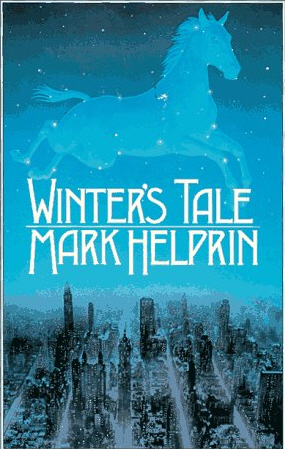
I discovered many writers while working there, reading things that shaped my current and later writing. Angela Carter’s Nights at the Circus, William Gibson’s Neuromancer, and J.G. Ballard’s Empire of the Sun all came out that year. Mark Helprin’s Winter’s Tale came out in 1983, and entered my life via a display of mass market paperbacks. I had read Ballard before Empire of the Sun (I think I started with the “Best of” collection), and I read Angela Carter’s Fireworks collection before Nights at the Circus. I also started reading Robert Coover during that period, but I lost interest in him quickly. Of those books, Neuromancer had the least influence for me. I liked it but it wasn’t what I wanted to write.
Carter and Ballard were much influenced by surrealist art, which was already an interest of mine. Helprin has more of a realistic style but with a magical feeling to everything…sure, call it magical realism. Would those be a big three of influences? I haven’t read anything of theirs in quite a while. It would be interesting to reread some things.
Babylonian Trilogy
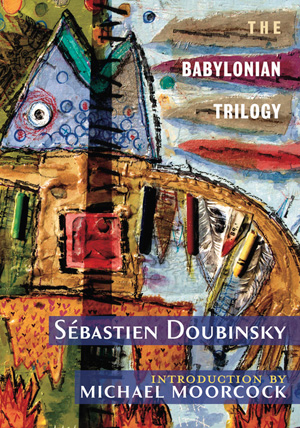 I recently finished reading The Babylonian Trilogy by Sébastien Doubinsky. The author is French, and this is his first book to be published in English. It’s one of those brain-rattling books that come along too rarely. I’m hoping it will help my current writing, slide some things around in my head till they find a better position.
Paul Witcover, in his review in Locus magazine, called it “a book whose images and characters seduce you one minute, then sucker-punch you the next.”
The setting is Babylon, a melted and mashed metropolis filled with decay, sensationalism, corruption, and beauty. The book is broken into three parts, “The Birth of Television According to Buddha,” “Yellow Bull,” and “The Gardens of Babylon” In “The Birth of Television According to Buddha,” multiple story lines and narrators alternate, including several amazing short-shorts about (or by) various colors, including:
Blue is the color of strangeness and tomorrows. It is the color of eyes and oceans. Seven is its number, and the sky is not a window. Painters use blue to express rage and lust. Blue is androgynous. Blue is the last color we will need for now. But blue is always where you expect it to be. For blue is the color of your shadow. Walk on the sunny side of the street on a cold summer day, and you will see.
“Yellow Bull,” the middle section, is the most straightforward, taking the form of a police procedural in which Georg Ratner, a disinterested police detective, is aided by dreams and nightmares to catch a serial killer. “The Gardens of Babylon” returns to a format of multiple story lines: Poetry, Death, and Dope (writer, assassin, junky).
The multiple stories and styles make it a difficult book to describe plot-wise, and in a way the plot is irrelevant. But despite its experimental clothing, the book builds story and character, characters who the reader cares about, creating a satisfying and intriguing whole.
To see some of what the author has to say about his writing, there’s a good interview here.
PS Publishing will release two more of his books next year, which is cause for rejoicing.
Bibliophile Stalker Interview
The amazing Charles Tan has posted an interview with me where I babble about various things.
 Laconic Writer