Valley of the Falling Clouds

Continuing with story note posts, here’s one for “Valley of the Falling Clouds.”
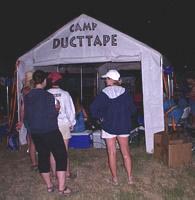
campducttapeIn June, 1996, I went to the Kerrville Folk Festival, a yearly music event held on a ranch outside Kerrville, Texas, in the Texas Hill Country, a land of cedar, prickly-pear cactus, and heat.  The festival has been going on since 1972. It lasts three weeks, with crowded outdoor concerts on weekends and smaller concerts during the week. Some people go just for the weekend concerts, some stay a few days, and others camp out for the entire festival. There’s a tradition of elaborate campsites that groups set up in the same place each year.

Someone has a page devoted to it here.

A lot of musicians who aren’t official performers go to play their songs in the campgrounds and hang out with friends. It’s like a science fiction convention but without the boring panels and pontification; also without a bar, but there’s no lack of drink.

I was sitting outside my tent, under a tarp, temperature at least 96 degrees, and I had an image of solidified clouds rolling down a hill and crushing someone’s house.

A story unfolded about Rex, his longing for Apple Jane the herbalist’s daughter, and his departure to the wilds beyond the town of Moonsocket, where he built a shack. A shack he hoped to share with Apple Jane.

For a long time I tried to have the story start with the cloud boulders rolling down the hill and crushing Rex’s shack, and then jump back and forth in time. Jumbled mess. It was one of the stories I submitted to Clarion West. The fifth week, tired, not getting anywhere with a new story, I revised it, re-arranging it in chronological order. Based on feedback, I took out assorted things. A few years later, unable to find a publisher and more confident about what belongs in a story I write (what makes a story my story and not someone else’s), I put everything back.

Maybe because of its origins at a music festival the story has various song references woven into it, “wind’s dominion” from a Butch Hancock song, the name Rex and “blue wind” from Townes Van Zandt’s “Rex’s Blues”.

Another inspiration for “Clouds” was wanting to write something like Jack Cady’s story, “The Bride,” which I read in Century, a magazine that gave me hope that my style of fantasy could be published and appreciated by a genre audience. An older inspiration, which I didn’t connect until re-reading it last year, was Richard Brautigan’s In Watermelon Sugar, which I first read in my early twenties; its subtle tone and matter-of-fact description of the fantastic helped shape my writing style.

In Nick Gevers’ Locus Magazine review of Polyphony 3, where “Valley of the Falling Clouds” first appeared, he described the story as “pastoral surrealism,” which I liked quite a bit.

It used to end differently, but life changes made that ending impossible.

Tales of the Golden Legend (the bread story)

The title for “Tales of the Golden Legend” comes from a Rene Magritte painting of loaves hovering outside a window. There was a major retrospective at the Menil Collection in Houston in 1992, and I mined Magritte imagery for a number of stories (most of which were unpublishable messes). The painting’s title refers to a medieval book on saints, but I didn’t know that when I wrote the story.

Soon after I moved to New York City from Austin in early ’95, I took a writing class with Carol Emshwiller. I met Carol through mutual friends and had read some of her short stories. The class was for beginning writing—I wasn’t a beginner, or at lest was less a beginner than some, having taken creative writing classes in college and attended a summer workshop. But, I was a beginner compared to Carol (still am and always will be…). She gave the class several writing exercises, some of which became “Tales of the Golden Legend”. The story is in four parts: Prolog: Bread, The Bread Dialogs, The Sound of Crust, and Epilog: Bread Aria.

Prolog: Bread began as a study in objective viewpoint, hovering outside of the characters, observing, showing a character’s emotional state through description of their actions.

The Bread Dialogs came out of an exercise in writing dialog. I decided to create a person who could hear the speech of bread. The character observed in the prolog emerges with a life, job, and a new-found relationship with bread.

The Sound of Crust. We read a Grace Paley story called “Mother” that involved scenes in doorways, the idea was to tie a story to a particular object or place. I decided to continue with bread, using an oven as the object and place on which the story hung. It’s been described as bread porn.

Epilog: Bread Aria wasn’t part of an exercise, but I wrote it for the class. I wanted something to end the story-suite, hoping to make the collection of separate pieces work as a whole. I returned to the objective viewpoint of the prolog but, where the prolog was a camera that observed and listened to the people, this camera could also hear the bread.

The story sold twice, first to Back Brain Recluse, in fall 1998; I was paid for it, but the magazine folded before publishing the story. I then sent it to Andy Cox of The Third Alternative, who published it in 2002. It has received a lot of favorable attention, mostly from other writers. However, one reviewer of the Third Alternative issue had problems with it. He said he had to force himself to keep from laughing while he read it. Someone else posted on a writer’s message board that the story made him cancel his subscription.

Thus ended my bread-in-fiction phase, although I have a fragment of a story called “The Baker” that I may finish someday.

Suspension

I’m home, snowed in, and posting a note for “Suspension,” the first story in my chapbook collection, Psychological Methods To Sell Should Be Destroyed

In 1997 I attended Clarion West, an intensive, six-week writing workshop in Seattle, for science fiction/fantasy/horror writers-and also for people like me, who aren’t exactly sf/fantasy/horror but aren’t realism either. Each week the workshop has a different writer or editor leading it, and the stories are critiqued by the other participants and that week’s leader.

The workshop was important both for my writing and because of the many friendships I made, with my fellow participants, instructors, the workshop organizers, Seattle-based writers who helped out at the workshop, etc. Clarion has the reputation of starting careers, starting marriages, ending marriages, and many participants give up writing after they leave the workshop.  I didn’t have a problem keeping at my writing.  But my Clarion experience did make me doubt whether I had any place in a genre best-known for elves and spaceships, neither of which I have an interest in writing about. At that time, no one in the genre was talking about slipstream, interstitial, new weird, or any other blend, and the literary journals weren’t interested in stories that had surreal/unreal elements unless they were translated from Spanish.

One instructor said it was too bad I wasn’t alive in the 19th century because I might have found a better reception then. Another suggested that I attend Borges lectures in New York (where I was living at the time) to see if I could meet publishers there. But I also had instructors like Nicola Griffith, Lucius Shepard, and Michael Bishop, who were great teachers and encouraged me to keep going.

“Suspension” was the first story I wrote at Clarion.

I had been thinking for a long time about a story based on the four-armed man in René Magritte’s painting The Sorcerer (shown here as a mouse pad!). Also, I had been reading some of Samuel Beckett’s prose and went to several Beckett plays; his work is filled with sedentary characters: people trapped in bed, in piles of sand… One day I was walking east on Grand Street, Lower Manhattan; up ahead was a very large woman. Seeing her, I wondered what would happen if she slipped and fell. How difficult would it be to lift her? That thought led to the man in the snow, which then combined with the Magritte painting, giving us a giant, four-armed man in the snow. I named him Quatrain Brauner (Quatrain for his four arms and Brauner for surrealist Victor Brauner).

The initial draft was third person and had some throwaway humor that didn’t need to be there. The original title was “The Sorcerer”, because of the Magritte painting, which caused unintended expectations—I hadn’t considered that the participants in a fantasy and science fiction workshop would automatically think there would be magic when they saw the title.

In revision, after Clarion, I changed it to first person, and to help me with his snow-bound philosophizing, I read some Frederich Nietzsche. I’ve forgotten what exactly I got from the Nietzsche or even what book it was. There are times (too few) when I find the perfect things to be reading while writing or revising something—I rarely take something specific from what I’m reading, but some thought or feeling or concept gets incorporated into sentence structure or becomes an image or scene. I wish this happened more often, but it’s impossible to know ahead of time what will be the perfect thing to read.

“Suspension” first appeared in the very excellent ’zine Lady Churchill’s Rosebud Wristlet.

Best of 2008

Jason Pettus of the intriguing website the Chicago Center for Literature and Photography (CCLP) has picked my collection Psychological Methods to Sell Must Be Destroyed for his list of best experimental books of 2008. There are some interesting-looking books mentioned, and I’m pretty happy about showing up on a list with M.John Harrison.

I first came across CCLP after I read Jack O’Connell’s The Resurrectionist, a book that had some fine writing but ultimately disappointed me. I was curious what people were saying about it and looked at reviews on Goodreads.com.  Jason Pettus’s review echoes some of the problems I had with the book, and so I clicked on the link to his website, where the review had originally appeared. I looked around the site briefly, planning to return when I had more time. Some weeks later I was looking at a post–on a blog, but I don’t remember which blog—about writer’s problems with reviewers. I clicked on a link to David Louis Edelman’s blog post on standards that a review should follow. The post ended with mentions of some reviews of his novel that reflected these standards, one of which was from CCLP.

After reading Edelman’s post I went back to CCLP, looked around some more, and queried about sending a review copy of Psychological Methods to Sell Must Be Destroyed, and was pleased with the ensuing thoughtful and intelligent, review.

Besides book reviews, CCLP collects interesting photographs from various sources (for example here), and also links to news reports, etc., with commentary.

I don’t have a lot of time for reading blogs (or writing one), but CCLP is one I try to visit often.