
Good interview with pal Mark Teppo, whose first novel, Lightbreaker, was recently released by Night Shade Books.
Author: Robert Freeman Wexler
Interzone Review
There’s a new review by Paul Kincaid of Psychological Methods To Sell Should Be Destroyed from Interzone 222 May/June 2009. The collection has been out about a year so I thought I’d reflect a bit.
Kincaid’s review is mostly positive, but negative in interesting ways. He dislikes the collection’s title and the first two stories, but that’s balanced by thoughtful analysis and a great appreciation for “Sidewalk Factory.”
“Best of the bunch, however, is…‘The Sidewalk Factory: A Municipal Romance’, which is worth the whole of the rest of this chapbook put together. It is a sort of anti-utopia: the inhabitants of an island state subject to increasingly absurd government decrees. The geography of the island, its regimented social structure, and its relationships with the client states along the mainland all recall Thomas More’s novel, but then it is twisted to distort the image just enough to make it interesting. I loved the fact that if you were able to accept the surreal elements of the world, the whole thing made a coherent sense. This was a place just on the edge of being believable, and within that shape everything the characters do and everything that is done to them makes perfect sense. This could become one of my favourite stories of the year.”
I haven’t read Thomas More’s Utopia, but perhaps will soon. Wikipedia calls it a novel but the county library lists it as non-fiction. Probably because it’s old and revered. Maybe someday my novels will be considered non-fiction.
Reading the widely-varying reviews of Psychological Methods To Sell Should Be Destroyed has been fascinating. There has been no consensus. One reviewer’s favorite is another reviewer’s dog food. It’s not good to dwell too much on reviews, but reviews do help indicate if the writing is connecting with a reader.
What I take from the disparity in reviewer tastes is that I’m doing the right thing. I’m not writing to please an audience; I’m writing because I’m driven to. I have ideas and I need to express them. I don’t expect to please everyone but I hope I please enough people so that I can keep getting published. That’s a pretty basic formula, and I’m sure every writer has their own way of approaching it.
And, speaking of connecting with readers, I was at Wiscon last weekend. A woman saw my name tag and said she bought the collection there last year and enjoyed it a lot. She especially loved “Suspension” and “Tales of the Golden Legend.” Which Kincaid did not care for at all. So, as I said, no consensus, but some interesting responses.
Something else Kincaid mentioned in his review is the use of surrealism.
The stories “are exercises in surrealism, an increasingly dominant mode among the upcoming generation of writers of the fantastic. But where some seem to feel that all they need to do is pile absurdity upon absurdity, not realising how hard it is to attract and retain the sympathy of the audience when anything can happen and so there are no consequences, Wexler introduces carefully controlled absurdity as if this is the way the world really is. It is that assumption of the real underlying the surreal that makes these much the better stories.”
He’s right about what I’m trying to do, convey the real and the surreal and maintain sympathy and empathy for my characters and situations. It’s funny that surrealism is an increasingly dominant mode in fantastic fiction because it’s what I’ve always done. If I allowed someone to read my horrendous early stories, starting with a creative writing class in 1982, they would see that I’ve been writing this way all along.
My interest in surrealism started with the visual art, probably Salvadore Dalí first, and then others. In fiction…I really can’t remember. Later, J.G. Ballard, Robert Coover, and Angela Carter, but when I first started writing I hadn’t heard of them. Kurt Vonnegut and Monty Python, definitely. Also, I was a subscriber to Fantasy and Science Fiction in the late ’70s/early ’80s and I’m sure I picked up some things there. The fat and fabulous 30th anniversary edition came out during that period.
Has it now become a “thing”? I hope someone does the definitive anthology, to go along with Slipstream, Steampunk, and New Weird. Or rather, I hope someone does the definitive anthology and includes me. Although, as I posted here, I’m part of the New Offbeat. Can I be both New Surreal and New Offbeat? It’s likely that the two are connected, with intertwined retinas and an auditorium full of attentive listeners waiting for the right color to crawl across their brains.
Painting and the City Sample
PS has put up a pdf sample of The Painting and the City. Click here to read the first two chapters.
Asimov’s Review
New review of Psychological Methods To Sell Should Be Destroyed, by Paul Di Filippo in the July Asimov’s (which is out now). “…intriguing conceits…couched in the most restrained yet emphatic and subtle prose, a style simultaneously droll and tragic, despairing and optimistic, wounded and triumphant.”
Special Offer
John Klima, publisher of the ’zine Electric Velocipede and several chapbooks of short fiction (including mine) is having a fund drive. Read about it here. To help him raise money, Prime Books is offering free copies of my novel, Circus of the Grand Design with a purchase of Psychological Methods To Sell Should Be Destroyed from the Electric Velocipede web store.
First Review
First review of The Painting and the City, from Charles Tan of Bibliophile Stalker; he’s also going to be running an interview with me in a couple of months.
I’ll be posting both positive and negative, as they come in. But it’s nice to start with a positive one. The book isn’t officially out till July, and most reviews won’t happen until then.
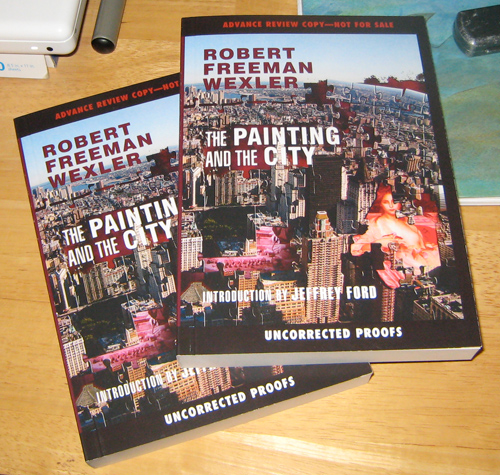
Advance Proofs
Here’s the nice treat that came in the mail yesterday.
Notebook Entry
The Painting and the City is off to the printer, so I thought I’d post on its origins.

The first particle of what became the novel occurred April 22, 2001 (although I wrote 2002 in my notebook, which confused me a lot when I went back to find the entry—from the very beginning, I was warping time…).
I had an image of two friends, one showing the other his new painting.
I was in Israel to attend my nephew’s bar mitzvah. My suitcase was missing and I had to wear my brother-in-law’s clothes. I was reading Joseph Conrad’s Nostromo. This proto-idea came out with a Latin American setting and characters, likely due to my being in a foreign country, wearing someone else’s clothes, reading a book by a Polish writer that was written in English and set in South America.
Hernandez called Saturday morning to tell him of a new painting. “I didn’t want you to see it, Gerardo. I know you’ll love it as I do.” Hernandez possessed great pride over his artistic and gastronomic tastes. They agreed to meet on the plaza for coffee first.
Gerardo had known Hernandez since college…
A couple of days later I made this list:
– visits friend to see painting again, and again
– party, looks at painting with others
– woman at party, friend starts seeing woman
– woman doesn’t like painting
And there it lay for many months, until I began unearthing the rest of the story, setting it in New York, without the Hispanic names.
Sidewalk Factory: A Municipal Romance
This is the last story in Psychological Methods To Sell Should Be Destroyed, and the last story note.
A few years ago, John Klima, editor of Electric Velocipede and publisher of this collection, asked me to send him a story for EV. I wanted to send John a new story that I hadn’t submitted anywhere else. I started working on something that began as a combination of three short-shorts dating from various periods. I was too involved with writing my novel The Painting and the City to spend much time on it, so I set it aside, and sent him an older story, “Travels Along An Unfurling Circular Path,” which appeared in Electric Velocipede #10.
Then, we decided to do the chapbook, and it needed a new story. I went back to work on the short-short idea.
“Sidewalk Factory” is set in a fictional island city-state, with the approximate dimensions of Manhattan. The story alternates between Lord Mayor’s Proclamation and Municipal Dispatches and a first-person narrative by an unnamed municipal worker.
Nick Gevers
Nick Gevers is an editor for PS Publishing and various anthologies, and a former reviewer of short fiction for Locus Magazine. I’m passing along an announcement of his new venture, which I’m looking forward to reading:
“Locus Online has just launched my new interview series, focusing on short fiction and titled “SF Quintessential”. In this slot, I’ll be talking regularly with influential figures in the field–authors and editors–tying in with the publication of new collections and anthologies, and looking at the state of the magazines. First up is Jonathan Strahan, discussing his superb anthology Eclipse Two. Soon: Lou Anders, on the dynamic Fast Forward 2.
“I intend that the series will help promote valuable short fiction publications and provide a forum for discussion of trends in the short form: creative movements and the rather troubled state of the market. There’s a huge amount to talk about; I hope “SF Quintessential” can supplement and augment existing debate, at a vital time in the history of genre literature.”
 Laconic Writer