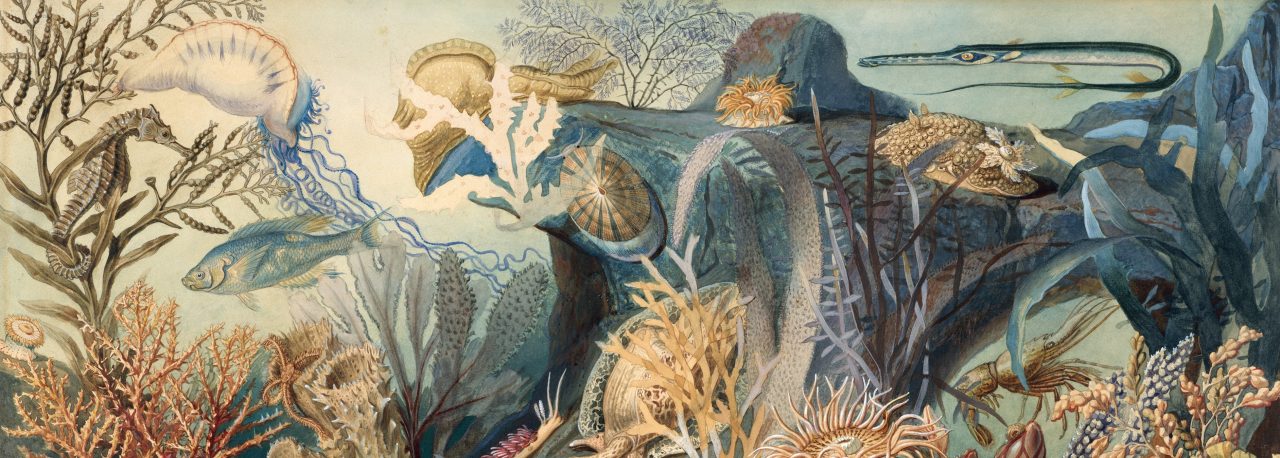
I’ve only just found out that Tim Robinson, who did the illustration for the cover of Psychological Methods To Sell Should Be Destroyed, has a blog. Go there and see what he’s been up to.
Category: Psychological Methods To Sell Should Be Destroyed
Zanzibar
 Announcing that French publisher Zanzibar Editions has picked up two books, The Painting and the City and Psychological Methods To Sell Should Be Destroyed. Writer and editor Anne-Sylvie Homassel (stories in English in Strange Tales and Strange Tales II from Tartarus Press) has begun translation. P&C should be out this summer…
Interzone Review
There’s a new review by Paul Kincaid of Psychological Methods To Sell Should Be Destroyed from Interzone 222 May/June 2009. The collection has been out about a year so I thought I’d reflect a bit.
Kincaid’s review is mostly positive, but negative in interesting ways. He dislikes the collection’s title and the first two stories, but that’s balanced by thoughtful analysis and a great appreciation for “Sidewalk Factory.”
“Best of the bunch, however, is…‘The Sidewalk Factory: A Municipal Romance’, which is worth the whole of the rest of this chapbook put together. It is a sort of anti-utopia: the inhabitants of an island state subject to increasingly absurd government decrees. The geography of the island, its regimented social structure, and its relationships with the client states along the mainland all recall Thomas More’s novel, but then it is twisted to distort the image just enough to make it interesting. I loved the fact that if you were able to accept the surreal elements of the world, the whole thing made a coherent sense. This was a place just on the edge of being believable, and within that shape everything the characters do and everything that is done to them makes perfect sense. This could become one of my favourite stories of the year.”
I haven’t read Thomas More’s Utopia, but perhaps will soon. Wikipedia calls it a novel but the county library lists it as non-fiction. Probably because it’s old and revered. Maybe someday my novels will be considered non-fiction.
Reading the widely-varying reviews of Psychological Methods To Sell Should Be Destroyed has been fascinating. There has been no consensus. One reviewer’s favorite is another reviewer’s dog food. It’s not good to dwell too much on reviews, but reviews do help indicate if the writing is connecting with a reader.
What I take from the disparity in reviewer tastes is that I’m doing the right thing. I’m not writing to please an audience; I’m writing because I’m driven to. I have ideas and I need to express them. I don’t expect to please everyone but I hope I please enough people so that I can keep getting published. That’s a pretty basic formula, and I’m sure every writer has their own way of approaching it.
And, speaking of connecting with readers, I was at Wiscon last weekend. A woman saw my name tag and said she bought the collection there last year and enjoyed it a lot. She especially loved “Suspension” and “Tales of the Golden Legend.” Which Kincaid did not care for at all. So, as I said, no consensus, but some interesting responses.
Something else Kincaid mentioned in his review is the use of surrealism.
The stories “are exercises in surrealism, an increasingly dominant mode among the upcoming generation of writers of the fantastic. But where some seem to feel that all they need to do is pile absurdity upon absurdity, not realising how hard it is to attract and retain the sympathy of the audience when anything can happen and so there are no consequences, Wexler introduces carefully controlled absurdity as if this is the way the world really is. It is that assumption of the real underlying the surreal that makes these much the better stories.”
He’s right about what I’m trying to do, convey the real and the surreal and maintain sympathy and empathy for my characters and situations. It’s funny that surrealism is an increasingly dominant mode in fantastic fiction because it’s what I’ve always done. If I allowed someone to read my horrendous early stories, starting with a creative writing class in 1982, they would see that I’ve been writing this way all along.
My interest in surrealism started with the visual art, probably Salvadore Dalí first, and then others. In fiction…I really can’t remember. Later, J.G. Ballard, Robert Coover, and Angela Carter, but when I first started writing I hadn’t heard of them. Kurt Vonnegut and Monty Python, definitely. Also, I was a subscriber to Fantasy and Science Fiction in the late ’70s/early ’80s and I’m sure I picked up some things there. The fat and fabulous 30th anniversary edition came out during that period.
Has it now become a “thing”? I hope someone does the definitive anthology, to go along with Slipstream, Steampunk, and New Weird. Or rather, I hope someone does the definitive anthology and includes me. Although, as I posted here, I’m part of the New Offbeat. Can I be both New Surreal and New Offbeat? It’s likely that the two are connected, with intertwined retinas and an auditorium full of attentive listeners waiting for the right color to crawl across their brains.
Asimov’s Review
New review of Psychological Methods To Sell Should Be Destroyed, by Paul Di Filippo in the July Asimov’s (which is out now). “…intriguing conceits…couched in the most restrained yet emphatic and subtle prose, a style simultaneously droll and tragic, despairing and optimistic, wounded and triumphant.”
Special Offer
John Klima, publisher of the ’zine Electric Velocipede and several chapbooks of short fiction (including mine) is having a fund drive. Read about it here. To help him raise money, Prime Books is offering free copies of my novel, Circus of the Grand Design with a purchase of Psychological Methods To Sell Should Be Destroyed from the Electric Velocipede web store.
Sidewalk Factory: A Municipal Romance
This is the last story in Psychological Methods To Sell Should Be Destroyed, and the last story note.
A few years ago, John Klima, editor of Electric Velocipede and publisher of this collection, asked me to send him a story for EV. I wanted to send John a new story that I hadn’t submitted anywhere else. I started working on something that began as a combination of three short-shorts dating from various periods. I was too involved with writing my novel The Painting and the City to spend much time on it, so I set it aside, and sent him an older story, “Travels Along An Unfurling Circular Path,” which appeared in Electric Velocipede #10.
Then, we decided to do the chapbook, and it needed a new story. I went back to work on the short-short idea.
“Sidewalk Factory” is set in a fictional island city-state, with the approximate dimensions of Manhattan. The story alternates between Lord Mayor’s Proclamation and Municipal Dispatches and a first-person narrative by an unnamed municipal worker.
Realms of Fantasy review
From Paul Witcover’s review of Psychological Methods To Sell Should Be Destroyed in Realms of Fantasy.
Wexler “builds his stories around flesh-and-blood people, human beings who, amid their bizarre surroundings and off-kilter circumstances, engage our feelings as well as our intellects….These are not stories of grand awakenings but of small epiphanies. They are as much about disenchantment as they are about enchantment. And they are funnier than you might think, especially “Tales of the Golden Legend,” which features such sage advice as “We can’t always do what bread says.” How true!”
Indifference
I was reading Harlan Ellison’s collection, I Have No Mouth And I Must Scream, and, when I reached the beginning of “Lonely Ache” and read the first sentence: “The Form of the Habit she had become still drove him to one side of the bed.” the idea of “Indifference” flowed into my head. I put the book down, went to my desk, and started writing.
“Indifference” references an unpleasant period of my life that had occurred a few months earlier. A relationship had ended (badly, of course); and assorted feelings combined with physical displacement (a move from Manhattan to Western Massachusetts) manifested into the story. The character Brown’s helplessness echoed what I had felt. Brown’s puzzlement over the coriander came from my own experience. But the head…like the solidified clouds in “Valley of the Falling Clouds,” the head appeared to me fully-formed, from whatever neighborhood of the subconscious holds such things.
I moved from Austin, Texas to New York City in January 1995; that winter was relatively mild, but the next year there was a major snowstorm that shut down the city for a day. I didn’t have to go to work, and went out walking. I needed to mail a package (probably a short story submission), and walked nine blocks to the post office on Canal Street, which turned out to be closed. It was eerie seeing the city so calm and white and still. In a nod to another of my stories, when Brown goes out into the snow-drenched streets, he witnesses the scene at the end of “Suspension.”
The story was published in the debut issue of a ’zine called Full Unit Hookup.
The Green Wall
I don’t remember where I got the image of a rain forest projected on wall. Or a portal to a rain forest appearing on a wall. Whichever it is depends on how you read tales of the fantastic. Part of what inspired “The Green Wall” was the short fiction of J.G. Ballard. I wanted to evoke some of his obsessional mystery, and his fiction is full of mirages and phantom images.
The wall was the wall outside my apartment window in New York (perhaps I was stuck for something to write, looked out the window, and said: what’s out there?—oh, a wall, maybe it has a rain forest on it). The Feast of San Gennaro takes place every autumn in Manhattan’s Little Italy and is little more than an excuse for fairground attractions, beer, and sausages. It isn’t much fun to experience as a resident of the neighborhood.
The art gallery in the story is based on a real place which no longer exists and shall remain unidentified, but I think anyone familiar with the New York art world knows a Hannah Rezinsky. Publishers are kittens compared to gallery owners. I’m glad I never worked for her nor was one of her artists, but I liked her just fine.
I hadn’t planned this when I wrote the story, but when I began working on my new novel, The Painting and the City, my idea for the sculptures of the main character, Jacob Lerner, matched the sculptures I described in “The Green Wall.” Because “The Green Wall” had not yet been published, I added something about Jacob Lerner to it, and incorporated the gallery owner into the novel (which takes place some years after Lerner has moved on to much more stable representation).
This story first appeared in Polyphony 5.
The New Offbeat
Here’s a snippet of a brief review by Rich Horton from the February Locus of Psychological Methods To Sell Should Be Destroyed.
“Other delvings into the small press turn up such treasures as Robert Freeman Wexler’s brief collection…half a dozen offbeat stories, notably the book’s one original, “The Sidewalk Factory: A Municipal Romance.”
Horton’s column also included the latest Lady Churchill’s Rosebud Wristlet, which he says is “as ever, packed with original and offbeat stories. My story, “Suspension,” appeared in a past issue of Lady Churchill‘s, and is in the collection, making it no doubt doubly offbeat.
My handy electronic dictionary defines offbeat as:
offbeat |ˈôfˌbēt; ˈäf-|
adjective
1 Music not coinciding with the beat.
2 unconventional; unusual : she’s a little offbeat but she’s a wonderful actress.noun Musicany of the normally unaccented beats in a bar.
There are a lot of labels and movements out there: magical realism, slipstream, interstitial, new weird, steampunk, etc., but I don’t know if I’m part of any of them. My stories have not appeared in their definitive anthologies. So I must be something else. I’m relieved to see a new one that I can claim. But am I Offbeat? Or New Offbeat? Has there been an Offbeat? Or an Onbeat? There were Beats, of course.
The next step is an Offbeat Manifesto, and a roster of fellow Offbeats, along with Proto-Offbeats (without which any movement is derailed before it starts).
 Laconic Writer