Story Fragment

Here’s a piece of something I’ve been working on. Working title of “Mountain Story.”

Reports of the new mountain began to arrive late in the week, and were immediately discounted as fabrication or illusion, of the sort that often explodes into public consciousness and dominates conversation until another replaces it.  Last year, there was the story of a hidden community of log-dwellers in the municipal parklands, and others, many others.

Early the next week, a man came into the Ministry of Parks and Justice building, a man with mud-caked clothing and a gashed forehead, a man who claimed proof.  Park stewards brought him to the director’s office, and the rest of the staff assembled.

No resident of The Expanse has seen a mountain (several hills yes, and two shallow gorges).  The existence of mountains has been speculated, but not confirmed, in a land somewhere below the southern horizon.  No modern expedition has yet ventured far enough, though records exist, accounts from the great explorer-captains of many years past, from an age of enquiry.

Continue reading “Story Fragment”

PS Three-For-Two Sale

PS is running a sale, buy any two books and get a third free. Even if you already own The Painting and the City, there are multitudes of excellent choices. How about: The Babylonian Trilogy, Everland and other Stories, and Val/Orson? Have a look at the site, and bring your wallet.

The Perfume and the City

I heard a report on NPR recently about the exploding market for celebrity scents. Not the actual scent of the celebrity (which would be much more interesting), and not, say, a scent that means, “Burt Reynolds in his Smokey and the Bandit period,” or “Lou Reed covered with glitter.” These are scents I could appreciate. No, what they seem to be talking about are scents celebrity-endorsed and named, developed for and assigned to a particular media star. How is this any different than celebrity-endorsed flannel sheets or health care plans?

Obviously, no one would be interested in an author-based perfume (not even that Twilight author’s), but what about the scent of a particular book? And not a book that has been transformed into a movie, with movie star identities assigned to it. Just a book. A good story. Maybe, one of my books…?

Being wealthy (like all writers), I’ve funded a research lab to develop some scents based on The Painting and the City. They’ll be available for purchase as soon as I have the shopping cart set up. Meanwhile, here’s a verbal introduction to the initial line of scents.

Lerner’s Studio

Fragrance Notes—an amalgam of earth and metal with a hint of chili pepper and cardamom. It’s charm lies in how it encourages the excitement of submerging oneself in whatever work most suits; for optimal effect, best applied early in the day.

Kreunen’s House

Fragrance Notes—Truffle oil, Hibiscus, Amber, Cognac. A scent that expands with use (or destroys the wearer). It carries no nostalgia or joy; best for any time you need to gain or maintain power over another.

Dapper Marionette

Fragrance Notes—Cinnamon and Adriatic Spearmint softened with hints of Dewy Green Leaves. Sensual and sophisticated, it offers one of the most intense olfactory experiences possible.

I’m sure many other books could provide exceptional scents that would dazzle and amaze. The Divinity Student: Something shocking and musty. The Babylonian Trilogy: A scent that says carnage and erudition. And many others, which will be under development soon.

DeNiro and Gregory Day

We’re here at Laconic Writer Central, talking to two rising stars of the literary world…but do stars rise?…don’t they expand with the rest of the universe, fusing hydrogen as they go…okay, so here I am with some emerging fusion generators of the literary world, the lovely and talented Alan DeNiro and Daryl Gregory.

Alan’s first novel, Total Oblivion, More or Less (Bantam Spectra), and Daryl’s second novel, The Devil’s Alphabet (DelRey) are out today.

If these books share anything (and let’s face it, I haven’t read them, I have no idea, I’m just making shit up here), if these books share anything, it’s a real-world setting gone askew and authors who craft their words and worlds with precision and dark humor.

They’ve stopped by LWC to answer a few questions before heading out on their first world tour together.

LWC: What was the inspiration for the novel?

AD: The inspiration for the novel came from several different places; I’m not sure if I can pin down one. Some travels in the Lake Pepin region of Minnesota/Wisconsin, where some of the first scenes of the novel came into being. The voice of Macy was a strong component from the outset. One of the other “what if” questions that came early on and informed the tone of the novel was: “What if my family growing up had to be taken to a refugee camp, and we had to leave everything behind? What would that be like for the modern American family?” Now, this is an experience that DOES happen throughout the world, today and throughout history. But in much of America, there is an abstract remove from these kinds of violent pressures. There isn’t TOO much of my actual family in Macy’s family, but it was that initial question that allowed some of the characterization to kick into gear.

DG: It started with the image of a twelve-foot tall, skeleton thin man with chalk-white skin. I didn’t know who he was, or what had made him that way, or if there were more like him… and it took me a long time to figure out those answers. Some I didn’t figure out until I was well into the writing of the book.

The second inspiration was my parents’ hometown, Rocky Branch, Tennessee. I grew up in Illinois, but my family visited Tennessee once or twice a year, and this book grew out of my experience as a Yankee with hillbilly roots, as an outsider-insider who was part of the culture but still standing outside it. The town of Switchcreek that appears in the book is quite different from Rocky Branch—there are no twelve-foot trolls, for example—but the inner landscape was there.

LWC: What was the writing process like–did you plan/outline ahead of time, work it out as you went?

AD: No outline at all. I worked it out as I went. I had a notebook of “jots and thoughts” with worldbuilding details I wanted to include, but for the most part I let the story take its course.

DG: The process was painful. I’ve blocked most of it out, now, but my wife remembers me whining a lot. For the first half of the book, I was flying blind, backtracking and rewriting and re-outlining every 20 pages. There were, however, moments of pure surprise, like the baptism scene, which came out of nowhere. It was that sense of discovery that kept me going in the early months.

Then somewhere around page 200 everything began falling into place. I knew why the characters were saying what they were saying, why they were acting so peculiarly, and what they secretly wanted. In retrospect, there was no other way for the book to work out — but only in retrospect. For much of the writing of the book I was wandering around the house in a state of fear, muttering, “I can never pull this off. What have I gotten myself into?” I suppose I shouldn’t admit that.

LWC: What animal (living, extinct, mythological, or combination) would you say represents the novel?

AD: One of those hybrid, saltwater/freshwater sharks that sometimes make their way up the Mississippi, just for the hell of it.

DG: Rabid dog. Not late stage rabid — I’m talking the early days, when it’s still sweet-natured and familiar, the dog you’ve raised from a pup…until it starts to act oddly. There’s a strange look in its eye. It starts to snap at shadows. You grow concerned. Then you lean down close to it and say, What’s the matter, boy?

You know how this ends. We all know how it ends. And when it does, it’s all right. It’s over, and it’s just you and the pup you raised.

LWC: What question have you never been asked in an interview but would like to answer?

AW: I’m more of a St. Paul person than a Minneapolis person. I love both cities dearly but since I’ve been up here I’ve either lived in St. Paul or on the eastern outskirts of the Saintly City. It’s a bit more muted now, but some of the rivalries of the two cities within the 20th century have been pretty crazy. Hey, thanks for asking!

DG: What is the opening sentence to a short story that you memorized in high school, and that you still occasionally chant to yourself while you are mowing or shoveling snow?

“They came to Alf Gunnderson in the Pawnee County Jail.”

It’s from Harlan Ellison’s “Deeper than Darkness.” I read this story my sophomore or junior year, and for the longest time I thought it was the perfect opening sentence: Who are they? What do they want with Alf Gunnderson? What has he done that they had to put him jail? So many narrative hooks, sunk so quickly.

But that was no reason to memorize it. It wasn’t until later that I realized that it wasn’t the function of the sentence that attracted me, but the rhythm of it. It still strikes me as a beautiful American sentence, almost noir. It’s straightforward, simple, and ends with a punch. In my own fiction I struggle mightily to open and close with sentences like that one.

LW: That’s it then, thanks for your time.

Now, everybody go out and buy the books, read them, and tell all your friends.
Dueling Releases

Two friends of mine (Daryl Gregory and Alan DeNiro) have novels being released tomorrow, and I’m going to post short interviews with both of them. So stay tuned.

Publisher’s Weekly on The Devil’s Alphabet:

A wide variety of believable characters, a well-developed sense of place and some fascinating scientific speculation will earn this understated novel an appreciative audience among fans of literary SF.

and on Total Oblivion, More or Less:

As this peculiar but entertaining first novel begins, geography and cosmology have shifted. Natural laws work unpredictably. The U.S. government has disappeared and plundering bands of Goths and Scythians roam the Midwest. Sea serpents close the shipping lanes, and oil companies convert their tankers into slave ships that cruise the Mississippi…an impressive debut from a promising writer.

Fountain Pens

In an older post I wrote about the deterioration of the pen department at Pearl Paint in Manhattan, and speculated on the whereabouts of the beloved “Pen Guy” who worked there. Yesterday another former Pearl Paint Pen Guy commented. Which got me thinking about my pens, and writing.

I used to write at the computer (and before computers, at the typewriter). I learned to do this in my first journalism class in college. A journalist is supposed to interview, make notes, and sit down to write the news story. I hope that’s still true. At some point I stopped writing at the keyboard. I don’t remember when, exactly. During the year I spent in Great Barrington, MA, I lived alone and worked free-lance from my apartment. I started going to cafes to write, partly to have social interaction.

Now I mostly I write in a notebook, away from the house. Later, I type what I wrote, print it out, and take it with my notebook the next time I write. I know people who write an entire draft longhand, then type, but I’ve never tried it.

I use a fountain pen, although I can also use other pens without my words falling apart.

Non-computer user Howard Waldrop has an occasional blog on the Small Beer Press web site. Here he talks about the fountain pens he uses.

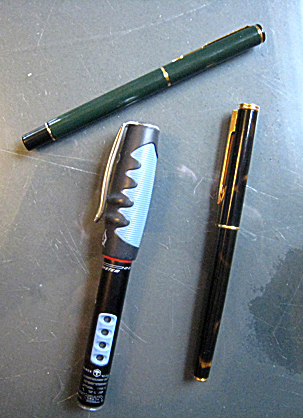
I have three fountain pens: Parker (top), Rotring—the fun one (left), and Waterman—the nice one (right). I rarely use the Waterman, which is a mistake because it wants to be used. It’s a nice pen, and I’m afraid of losing it if I take it out. I did lose my Parker but replaced it via eBay. I bought the original Parker from the Pen Guy for $10. It was a closeout that he thought I needed (and he was right). The last time I remember having it was at the Flight Path Cafe in Austin, a day after the 2006 World Fantasy Convention, and a day before meeting Howard for coffee.

A wine rep who sells to the Emporium in Yellow Springs is also a collector of vintage fountain pens. He is unimpressed by my modern pens, even the Waterman. I’m interested in the more finely-crafted vintage instruments and might like to own one some day, but I’m happy with what I have.

World Fantasy Wrap-up

Anyone expecting a convention report from me during or even right after a convention should look at my never-quite-caught-up New York trip report here. Immediate reporting is not the forte of the department of laconic writing. I’m still trying to figure out what to say about J.G. Ballard’s death in April.

World Fantasy 2009 PR 2_FINAL_WEB

I hadn’t been to World Fantasy in three years. It’s a convention that I always enjoy, but this year’s felt larger and less comfortable than I remembered, maybe because the hotel floor that housed the events was a confusing labyrinth, and also because my getting there was difficult and I never felt caught up on sleep.  There were people I knew would be there and had even communicated with ahead of time, but never saw them.  But I did see a lot of old friends, including people from my Clarion West ’97 class, with whom I can always slip into easy familiarity. As usual, I spent much of my time sitting around talking to people about writing.

The highlight was meeting Zoran Zivkovic in person, after having corresponded via email for several years. I also got to meet Jill Roberts, from Tachyon, for whom I did interior design and layout for Carol Emshwiller’s novel, The Secret City.

The book bag contained some gems, including Leigh Brackett’s Sword of Rhiannon (which was the perfect read for the long flight home), and Tom Disch’s The Wall of America and The Word of God, from Tachyon. And some less desired objects, which I donated to the discard table.

My only scheduled event was a reading Friday morning. I read from The Painting and the City, a shorter version what I’ve been reading. I missed having Brady’s guitar-playing, but maybe next year in Columbus he can accompany me.

My friend Ben, from Texas, who’s now living in San Francisco and whom I hadn’t seen in five years, came over to San Jose for the evening on Friday; we had mediocre fish and chips with jazz combo at a place near the hotel. There was a small Vietnamese neighborhood a few blocks away with several excellent restaurants, which I unfortunately didn’t discover till Saturday afternoon.

And next year’s World Fantasy is an hour’s drive from my house.

Bookstore Days

The recent news that Barnes and Noble is closing its B. Dalton stores got me thinking back to when I worked at a Waldenbooks, starting in June 1984. B. Dalton and Waldenbooks were shopping mall bookstores, precursors to the giant chains of Borders and Barnes and Noble. I don’t know who (what corporate entity) owned B. Dalton then; KMart owned Waldenbooks.

MarkHelprin_WintersTaleAt the time, these chains still carried actual books. The one where I worked was in Hancock Plaza (in Austin), an older, pre-mall shopping center, with stores facing an open-air courtyard. The store was much smaller than its fellow stores in the newer shopping malls, and the staff were not know-nothing mall-store employees. We actually liked and read books.

The store’s inventory was determined elsewhere, regional managers, or perhaps KMart accountants…but because the store was small, we had a lot of freedom to add extra books that didn’t appear in corporate lists. You could order books for the store but they rarely came. It worked better to treat them as special orders for a customer, and then put them on the shelf.

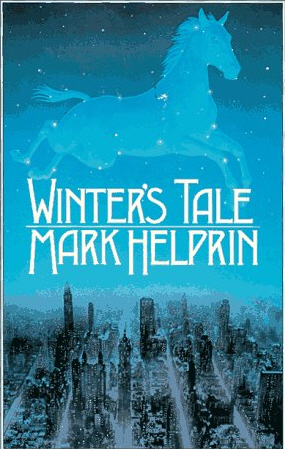
I discovered many writers while working there, reading things that shaped my current and later writing. Angela Carter’s Nights at the Circus, William Gibson’s Neuromancer, and J.G. Ballard’s Empire of the Sun all came out that year. Mark Helprin’s Winter’s Tale came out in 1983, and entered my life via a display of mass market paperbacks. I had read Ballard before Empire of the Sun (I think I started with the “Best of” collection), and I read Angela Carter’s Fireworks collection before Nights at the Circus. I also started reading Robert Coover during that period, but I lost interest in him quickly. Of those books, Neuromancer had the least influence for me. I liked it but it wasn’t what I wanted to write.

Carter and Ballard were much influenced by surrealist art, which was already an interest of mine. Helprin has more of a realistic style but with a magical feeling to everything…sure, call it magical realism. Would those be a big three of influences? I haven’t read anything of theirs in quite a while. It would be interesting to reread some things.