April is Emshwiller Month

I’m heading to New York next week for part one of the Carol Emshwiller birthday events.

Tuesday, April 12, The New York Review of Science Fiction Readings

The SoHo Gallery for Digital Art
138 Sullivan Street
Doors open at 6:30 PM
Program begins at 7:00
Admission Free
$7 donation suggested

There’s a second event the following Monday, but I’ll be back home.

Monday, April 18, the Wold Newton Reading Series will offer an interview of Carol Emshwiller by Matthew Cheney. There will also be magic Magic Brian.

Details: April 18, 2011, 7.30pm/WORD Bookstore in Greenpoint, Brooklyn/126 Franklin Street, Brooklyn, NY 11222

And, there’s a web compendium for information and Emshwiller tributes here.

New books by some people

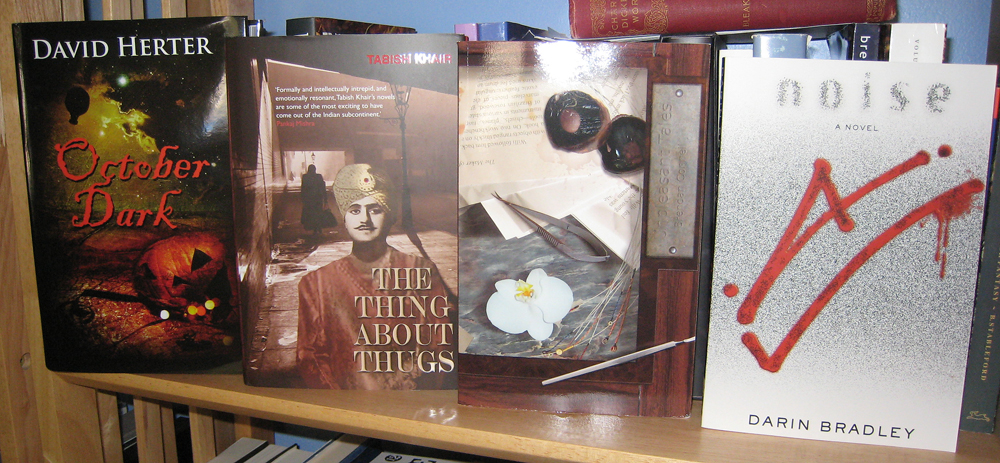
Here are four recent books by friends, some purchased, some traded for, a combination of presses small, large, and far away.

David Herter’s October Dark part of Earthling Publication’s Halloween series. From Library Journal:

“In OCTOBER DARK, so-called movie magic is real, the special effects masters are its practitioners, and it’s the only thing protecting the world from unspeakable evil. Filled with nostalgia triggers for baby boomers and Gen Xers alike, with an original story and the liberally dropped names of a pantheon of horror moviemakers, OCTOBER DARK is a delight.”

Tabish Khair, The Thing About ThugsHarper Collins-India. From India Times:

“Partly, perhaps, the world Khair creates seems so real because foggy Victorian London is so well entrenched in the imagination. However, much more is due to Khair’s own peculiar genius. He is a renowned poet, and like many poets before him, has a rare gift for prose. He can, in a few words, a brief alliterative phrase, conjure up a picture, inspire horror, pity, fear or love. He has also crafted a novel full of suspense where the various strands of mystery, human relationships and crime are expertly woven into one absorbing and fast-moving tale. This is a book that deserves to stand the test of time and join the other masterpieces of Victorian London.”

Brendan Connell, Unpleasant Tales, EibonVale Press. Blurb from Rhys Hughes:

“Every generation throws up a few genuine Masters of the Weird. There simply is no hyperbole in the statement that Brendan Connell is a member of this elite group right now, perhaps the most accomplished of them all. His work is very strange but always proceeds with rigorous logic and his use of language is original, concise and often startling, employing the alchemy of a ferocious intelligence to create dreamscapes that have the solidity and cruelty of stone and iron. The blend of profound melancholy, decadent atmosphere and abstruse erudition work beautifully and the magic of his prose gets under the skin of your soul and remains there forever.”

Darin Bradley, Noise, Bantam-Spectra. From the Bantam page:

“This haunting debut from a brilliant new voice is sure to be as captivating as it is controversial, a shocking look at the imminent collapse of American civilization—and what will succeed it.”

I’m looking forward to some reading…

FashionPunk

Jon Armstrong, author of Grey and the forthcoming Yarn and Loom, is the leading and perhaps sole practitioner of the new genre of FashionPunk.

In Grey, which I just finished reading, the main character and much of society are true dedicated followers of fashion, building their lives around their anthemic magazines and music. Armstrong takes this concept and pushes it with vigor. Fashion is the lens through which the main character sees the world. Maintaining this fashion-centric viewpoint is one of the most admirable parts of this admirable book.

Yarn, which is, I believe, set before Grey and features a minor character from Grey, is up for pre-order at Night Shade’s website, and Night Shade is currently running an offer of half-off current books and pre-orders, So this would be an excellent time to pick up some great books.

Locus List

Very happy to see The Painting and the City on Locus magazine’s 2009 Recommended Reading List. Nothing of mine has made the list since In Springdale Town in 2003.

I would have liked to see some other books on there, Marly Youman’s Val/Orson for novella, and Sebastíen Doubinsky’s The Babylonian Trilogy under one of the novel categories…is it fantasy…science fiction…? The list is put together by Locus staff and reviewers “with inputs from outside reviewers, other professionals, other lists, etc.” A work has to receive at least two nominations to make the list. Reviewers generally only have time to read the books that they are reviewing, so if Locus gives a book one review, and the staff and other reviewers don’t read a particular book (or some read it and don’t find it worth recommending), then it takes the outside input to provide the other recommendations. Paul Witcover recommended The Babylonian Trilogy on his blog (and presumably in the magazine as well), but there obviously wasn’t a second vote, which is a shame because it’s a book that deserves more attention.

The Perfume and the City

I heard a report on NPR recently about the exploding market for celebrity scents. Not the actual scent of the celebrity (which would be much more interesting), and not, say, a scent that means, “Burt Reynolds in his Smokey and the Bandit period,” or “Lou Reed covered with glitter.” These are scents I could appreciate. No, what they seem to be talking about are scents celebrity-endorsed and named, developed for and assigned to a particular media star. How is this any different than celebrity-endorsed flannel sheets or health care plans?

Obviously, no one would be interested in an author-based perfume (not even that Twilight author’s), but what about the scent of a particular book? And not a book that has been transformed into a movie, with movie star identities assigned to it. Just a book. A good story. Maybe, one of my books…?

Being wealthy (like all writers), I’ve funded a research lab to develop some scents based on The Painting and the City. They’ll be available for purchase as soon as I have the shopping cart set up. Meanwhile, here’s a verbal introduction to the initial line of scents.

Lerner’s Studio

Fragrance Notes—an amalgam of earth and metal with a hint of chili pepper and cardamom. It’s charm lies in how it encourages the excitement of submerging oneself in whatever work most suits; for optimal effect, best applied early in the day.

Kreunen’s House

Fragrance Notes—Truffle oil, Hibiscus, Amber, Cognac. A scent that expands with use (or destroys the wearer). It carries no nostalgia or joy; best for any time you need to gain or maintain power over another.

Dapper Marionette

Fragrance Notes—Cinnamon and Adriatic Spearmint softened with hints of Dewy Green Leaves. Sensual and sophisticated, it offers one of the most intense olfactory experiences possible.

I’m sure many other books could provide exceptional scents that would dazzle and amaze. The Divinity Student: Something shocking and musty. The Babylonian Trilogy: A scent that says carnage and erudition. And many others, which will be under development soon.

DeNiro and Gregory Day

We’re here at Laconic Writer Central, talking to two rising stars of the literary world…but do stars rise?…don’t they expand with the rest of the universe, fusing hydrogen as they go…okay, so here I am with some emerging fusion generators of the literary world, the lovely and talented Alan DeNiro and Daryl Gregory.

Alan’s first novel, Total Oblivion, More or Less (Bantam Spectra), and Daryl’s second novel, The Devil’s Alphabet (DelRey) are out today.

If these books share anything (and let’s face it, I haven’t read them, I have no idea, I’m just making shit up here), if these books share anything, it’s a real-world setting gone askew and authors who craft their words and worlds with precision and dark humor.

They’ve stopped by LWC to answer a few questions before heading out on their first world tour together.

LWC: What was the inspiration for the novel?

AD: The inspiration for the novel came from several different places; I’m not sure if I can pin down one. Some travels in the Lake Pepin region of Minnesota/Wisconsin, where some of the first scenes of the novel came into being. The voice of Macy was a strong component from the outset. One of the other “what if” questions that came early on and informed the tone of the novel was: “What if my family growing up had to be taken to a refugee camp, and we had to leave everything behind? What would that be like for the modern American family?” Now, this is an experience that DOES happen throughout the world, today and throughout history. But in much of America, there is an abstract remove from these kinds of violent pressures. There isn’t TOO much of my actual family in Macy’s family, but it was that initial question that allowed some of the characterization to kick into gear.

DG: It started with the image of a twelve-foot tall, skeleton thin man with chalk-white skin. I didn’t know who he was, or what had made him that way, or if there were more like him… and it took me a long time to figure out those answers. Some I didn’t figure out until I was well into the writing of the book.

The second inspiration was my parents’ hometown, Rocky Branch, Tennessee. I grew up in Illinois, but my family visited Tennessee once or twice a year, and this book grew out of my experience as a Yankee with hillbilly roots, as an outsider-insider who was part of the culture but still standing outside it. The town of Switchcreek that appears in the book is quite different from Rocky Branch—there are no twelve-foot trolls, for example—but the inner landscape was there.

LWC: What was the writing process like–did you plan/outline ahead of time, work it out as you went?

AD: No outline at all. I worked it out as I went. I had a notebook of “jots and thoughts” with worldbuilding details I wanted to include, but for the most part I let the story take its course.

DG: The process was painful. I’ve blocked most of it out, now, but my wife remembers me whining a lot. For the first half of the book, I was flying blind, backtracking and rewriting and re-outlining every 20 pages. There were, however, moments of pure surprise, like the baptism scene, which came out of nowhere. It was that sense of discovery that kept me going in the early months.

Then somewhere around page 200 everything began falling into place. I knew why the characters were saying what they were saying, why they were acting so peculiarly, and what they secretly wanted. In retrospect, there was no other way for the book to work out — but only in retrospect. For much of the writing of the book I was wandering around the house in a state of fear, muttering, “I can never pull this off. What have I gotten myself into?” I suppose I shouldn’t admit that.

LWC: What animal (living, extinct, mythological, or combination) would you say represents the novel?

AD: One of those hybrid, saltwater/freshwater sharks that sometimes make their way up the Mississippi, just for the hell of it.

DG: Rabid dog. Not late stage rabid — I’m talking the early days, when it’s still sweet-natured and familiar, the dog you’ve raised from a pup…until it starts to act oddly. There’s a strange look in its eye. It starts to snap at shadows. You grow concerned. Then you lean down close to it and say, What’s the matter, boy?

You know how this ends. We all know how it ends. And when it does, it’s all right. It’s over, and it’s just you and the pup you raised.

LWC: What question have you never been asked in an interview but would like to answer?

AW: I’m more of a St. Paul person than a Minneapolis person. I love both cities dearly but since I’ve been up here I’ve either lived in St. Paul or on the eastern outskirts of the Saintly City. It’s a bit more muted now, but some of the rivalries of the two cities within the 20th century have been pretty crazy. Hey, thanks for asking!

DG: What is the opening sentence to a short story that you memorized in high school, and that you still occasionally chant to yourself while you are mowing or shoveling snow?

“They came to Alf Gunnderson in the Pawnee County Jail.”

It’s from Harlan Ellison’s “Deeper than Darkness.” I read this story my sophomore or junior year, and for the longest time I thought it was the perfect opening sentence: Who are they? What do they want with Alf Gunnderson? What has he done that they had to put him jail? So many narrative hooks, sunk so quickly.

But that was no reason to memorize it. It wasn’t until later that I realized that it wasn’t the function of the sentence that attracted me, but the rhythm of it. It still strikes me as a beautiful American sentence, almost noir. It’s straightforward, simple, and ends with a punch. In my own fiction I struggle mightily to open and close with sentences like that one.

LW: That’s it then, thanks for your time.

Now, everybody go out and buy the books, read them, and tell all your friends.